~/nsa-hawaii $ rsync -a ./classified/ ./conscience/ // transfer complete. no turning back.
SNOWDEN
the contractor who told you · everything since runs encrypted because he did
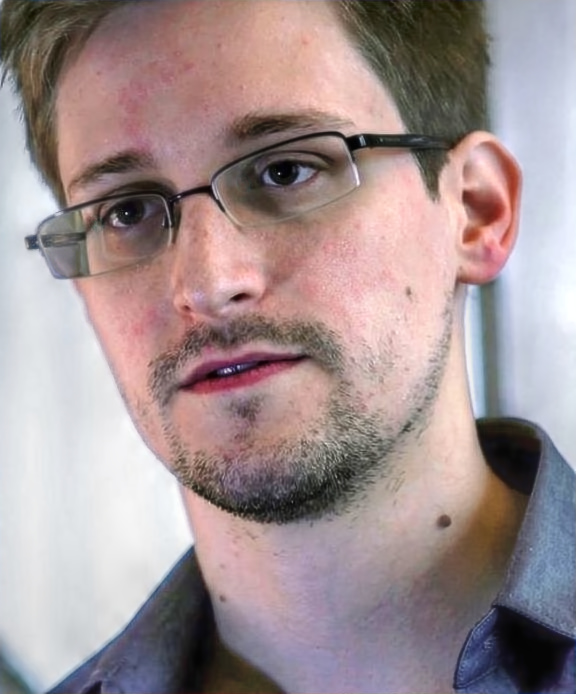
systems administrator, NSA Hawaii via Booz Allen · source of the 2013 disclosures ·
wikipedia ⇗
photo: laura poitras / praxis films, cc by 3.0
[01] THE LEAK
In June 2013 a 29-year-old systems administrator proved that the paranoids had been under-reacting.
Edward Snowden had the keys to the kingdom: an infrastructure analyst at the NSA's Hawaii station, cleared into the programs the agency denied under oath. He copied the proof, told his girlfriend he'd be away for a few weeks, and flew to Hong Kong. In a hotel room at the Mira he met Glenn Greenwald, Laura Poitras, and Ewen MacAskill, identifying himself with a Rubik's cube and opening with the words every journalist dreams about: I can prove it.
On June 5 the Guardian published a secret court order forcing Verizon to hand over the call records of every customer, every day, terrorist or toddler. On June 6, PRISM. Then he did the thing nobody does: he put his own name on it. No anonymous drip, no hiding behind the journalists. "I have no intention of hiding, because I know I have done nothing wrong."
// subject file
| born | june 21, 1983, north carolina |
| route in | army (washed out, broken legs) → CIA → dell → booz allen, NSA hawaii |
| clearance | TS//SCI, the rooms behind the rooms |
| the meeting | mira hotel, hong kong · recognition signal: a rubik's cube |
| first story | june 5, 2013. the verizon order, all calls, all customers, daily |
| the reveal | june 9, 2013. on camera, by name, by choice |
// the day "conspiracy theory" was reclassified as "journalism."
[02] THE HAUL
Court-stamped collection straight from Microsoft, Google, Apple, Facebook, and friends: mail, chats, photos, video calls. The companies denied knowing the codename. The slides listed their onboarding dates. Full dossier ▸
A search engine over your life: "nearly everything a typical user does on the internet," queryable by any cleared analyst with a justification field nobody read. No warrant in the workflow.
Every American phone call's metadata, collected daily under a law about "relevant" business records. Who you called, when, for how long, from where. Relevant, because everything was.
GCHQ tapping the transatlantic fiber itself; MUSCULAR tapping the private links between Google's own datacenters. The slide marked where encryption ended with a hand-drawn smiley face.
The agency's own dashboard, counting billions of records per month, screenshotted weeks after its director of national intelligence told the Senate it collected "not wittingly." The lie came with a graph.
Allied agencies trading each other's citizens like baseball cards: what's illegal to collect at home is a gift from a friend abroad. Domestic spying, laundered through an accent. Full dossier ▸
$ xkeyscore --target anyone@anywhere --justification "trust me"
[✓] inbox   [✓] history   [✓] location   [✓] contacts
// warrant: not found. proceeding anyway.

// "I, sitting at my desk, certainly had the authorities to wiretap
//  anyone, from you or your accountant, to a federal judge or even
//  the president, if I had a personal email."  — snowden, june 2013
// they called it a lie. then the xkeyscore docs printed the search form.
[03] THE PRICE
He was charged on his 30th birthday under a law from 1917 that forbids the only defense he has: telling the jury why.
The Espionage Act makes no distinction between selling secrets to an enemy and handing proof of government lawbreaking to journalists. Motive is inadmissible. Public interest is inadmissible. So he ran, and the run wrote the smear for them: en route to Latin America, the State Department canceled his passport mid-journey, stranding him in the Moscow airport for 39 days. "Why Russia?" Because that's where the plane was when they killed the passport. He's lived in Moscow since, married Lindsay Mills there, is raising two sons, and took Russian citizenship in 2022 so his family can't be made stateless. When his memoir Permanent Record came out in 2019, the US government sued, not to stop the book, but to take the money. It became a bestseller anyway.
// asked if he'd do it again: "yes." every time, "yes."
[04] THE LESSON
In 2013 most of the web traveled in plaintext. Today HTTPS is the default, Signal exists at scale, and WhatsApp encrypts billions of conversations end-to-end. The smiley face on that slide cost the agencies the open wire.
The USA Freedom Act of 2015 ended bulk collection of phone metadata. First rollback of surveillance powers since the 1970s. In 2020 a federal appeals court ruled the program had been unlawful all along, citing his disclosures.
SecureDrop in every serious newsroom, encrypted channels as standard practice, and a generation of reporters who treat the metadata as the story. Sources survive now because 2013 taught the trade what the dragnet sees.
"Arguing that you don't care about the right to privacy because you have nothing to hide is no different than saying you don't care about free speech because you have nothing to say." The full argument lives here ▸
One conscience outweighed the largest surveillance apparatus in history. That math should encourage you.
He bet his life that the public, once told, would care, and the internet you're reading this on is the payout: encrypted by default, suspicious by training. Believing him is free. Acting on it costs a weekend: read why privacy comes first, read the manifesto he proved right twenty years late, then install the stack.
// he kept his oath. it was to the constitution, not the agency.